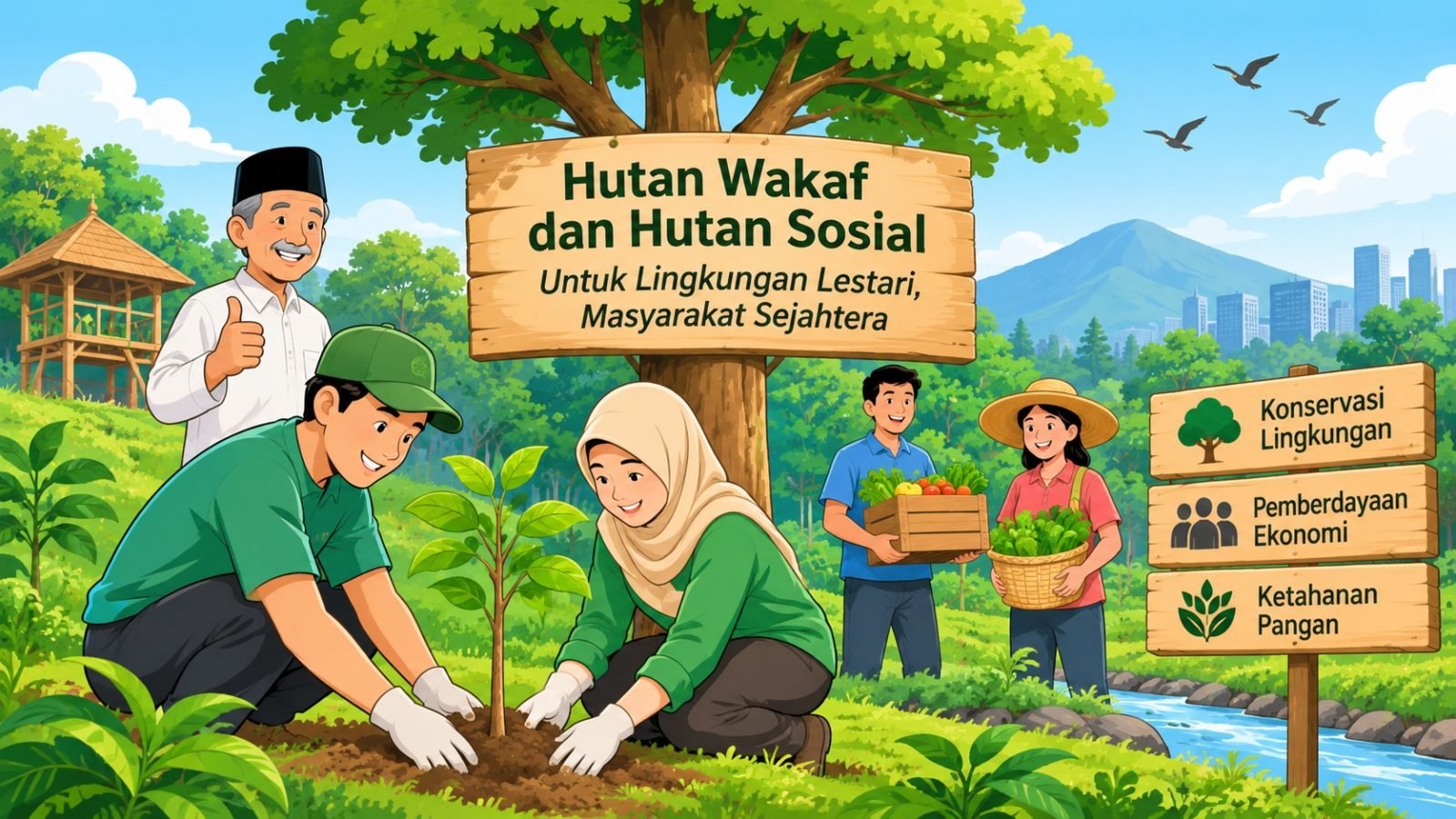
Beyond the efforts to preserve nature, Waqf Forests and Social Forests are social entrepreneurship movements that make environmental sustainability a source of community welfare and cross-generational benefit.
Introduction
Starting from concerns about the recent hot weather and news of the rainy season accompanied by strong winds in the southern part of Bojonegoro, one of the causes is forest degradation in that area. Certainly, we want to contribute a few thoughts to improve this situation with the concept of a waqf forest, as has been developed by our brothers and sisters in other regions, such as the YPM waqf forest in Mojokerto and the waqf forest in Bogor. A waqf forest refers to a forest area or land, whether it is already a forest or critical land, that is named or endowed (waqf) to be managed for forest functions, namely conservation, ecology, education, and agroforestry. This forest is built on waqf land, so its legal status is permanent; it cannot be sold, inherited, or repurposed, in order to maintain environmental sustainability and the benefit of the community.
In addition to waqf forests, there are what are called social forests. The definition of social forest or social forestry is a sustainable forest management system implemented within state forest areas or customary/rights forests managed by local communities or customary law communities as the main actors. Both forms of forests have a main similarity in maintaining environmental sustainability while improving the welfare of the surrounding community, but they differ fundamentally in terms of land ownership status, legal basis, and management initiators. Waqf forests are built on private land voluntarily endowed by the community, while social forestry is an official government program that provides access rights to manage state forest areas or customary forests.
The following are the main reasons why these two concepts are urgent to be discussed and developed:
1. Indonesia faces major challenges related to the loss of primary forests and the threat of climate change. Waqf forests that are managed sustainably and cannot be sold or repurposed maintain ecological functions such as carbon sequestration and watershed buffers.
2. Economic empowerment of communities around the forest through the Social Forestry scheme managed by the government. Local communities are given legal access rights to manage the forest productively, for example, planting coffee, avocados, trigona honey, and developing ecotourism without having to destroy trees. Waqf forests are not only oriented towards growing trees but also produce sustainable economic benefits such as agricultural products or carbon endowment funds that go directly back to the benefit of the community and surrounding residents.
3. Access Justice and Food Security. Social forestry ensures that communities living around forest areas have legal rights and are not marginalized by large corporations, thereby creating harmony between conservation and livelihoods. Through the integration of local food crops and agroforestry, this program strengthens the food security of village communities.
Synergy of Waqf Forests with Sociopreneurship
Waqf forests in Indonesia function as green sociopreneurship instruments that combine environmental preservation with community economic empowerment. Through the concept of productive waqf, permanent land assets are managed as social businesses to solve the problem of deforestation while improving the welfare of surrounding residents. The meeting point of Waqf Forests and Sociopreneurship is in the sustainability of capital and assets. In sociopreneurship, maintaining the continuity of basic capital is often a major challenge. Waqf land is permanent and bound by religious and state laws; it cannot be sold, inherited, or repurposed, thus ensuring the availability of business and conservation land forever.
The sociopreneurship approach changes the position of local residents from potential forest encroachers to the main subjects of ecosystem management. The community is directly involved in seeding, tree care, and processing harvests to earn a decent income. The profits generated from economic activities in the waqf forest are not enjoyed by individual capital owners, but are reinvested to fund the expansion of forest areas, informal education programs, health services, and social assistance for residents.
The synergy of both aligns the goals of profit (economy), people (social), and planet (ecology), which are realized through the main pillars of waqf forests such as ecology, economy, and education.
Social Business Models in Waqf Forests
Waqf forest managers (nazhir) in Indonesia apply various social business models so that the forest remains sustainable without cutting down trees. Planting commodities with economic value under the forest canopy, such as coffee, avocados, durians, red ginger, and herbal plants. Maintaining forest canopy cover and preventing erosion while providing regular harvests for local farmers. Cultivation of trigona honey bees, production of essential oils, and processing of derivative products such as local coffee brands (Waqf Forest Coffee).
This business creates a halal economic value chain and opens new job opportunities for youth and women's groups. Providing living laboratory facilities for research, conservation-based nature tourism, and nature contemplation programs. Improving community environmental literacy while generating income from tourism services and training. Raising cash waqf through digital platforms or carbon endowment fund schemes for the expansion of critical land. Reducing dependence on conventional donors and accelerating the rehabilitation of disaster-prone land.
Examples of Implementation in Indonesia
The Bogor Waqf Forest, managed by the Bogor Waqf Forest Foundation in Cibunian Village, Pamijahan, is an initiative that develops coffee agroforestry, trigona honey cultivation, and involves youth organizations in marketing environmentally friendly products in landslide-prone buffer zones.
B2B Scheme Carbon Credit (YPM Waqf Forest): Managed by the Maarif Sepanjang Education and Social Foundation with a focus on maintaining ecological balance and forest management research. The manager sells carbon credits to companies on a business-to-business (B2B) basis to fund forest maintenance, reforestation, and environmental benefits for surrounding residents.
Synergy of Social Forests with Sociopreneurship
The social forestry program provides legal rights to local communities to manage and benefit from state forest areas to improve their welfare. It is a business approach whose main goal is not just to seek financial profit, but to solve social and environmental problems.
Social forests and sociopreneurship (social entrepreneurship) have a reciprocal relationship where social forests provide natural resources and legal access for the community, while sociopreneurship turns that potential into sustainable businesses to improve the welfare of residents while preserving the environment.
In the Indonesian context, such as the Social Forestry scheme managed by the Social Forestry Business Group (KUPS), the connection between the two can be seen through the following main aspects:
1. Social Forest as Space and Basic Capital
Social forestry programs such as Village Forests, Community Forests, or People's Plantation Forests provide official management rights to communities around the forest. This access prevents land conflicts and opens opportunities for the emergence of community-based business initiatives without having to destroy tree stands.
2. Sociopreneurship as a Value-Added Driver
Sociopreneurs (social entrepreneurs) play a role in bridging forest products with the modern market. Instead of selling raw materials at low prices or engaging in illegal logging, the social entrepreneurship approach encourages innovation such as processing forest honey, agroforestry coffee, pine resin, rattan, or mushrooms into high-value packaged products. Developing conservation-based ecotourism or carbon trading and connecting forest farmers directly with consumers or industries that care about sustainability.
The synergy between social forests and sociopreneurship produces two mutually reinforcing benefits. Business profits are reinvested to increase the income of forest farmer group members, create jobs in villages, and fund local social facilities. When the community feels the direct economic benefits of a sustainable forest, they have a strong incentive to protect the forest from fires, encroachment, and illegal logging.
Real Examples in the Field
Many Social Forestry Business Groups (KUPS) in various regions, including in East Java, such as coffee management on mountain slopes or forest ecotourism, have transformed into social enterprises. They apply a fair profit-sharing system for tenant farmers while requiring the planting of shade trees to maintain the ecosystem.
Downstreaming of Non-Timber Forest Products (NTFP) & Local Food; Where the community processes commodities from social forestry areas into value-added products, such as turning cassava into various chips, processing molded palm sugar into granulated sugar, or making red ginger preparations and rattan furniture. The sociopreneurship approach helps improve skills, packaging, and market absorption.
Implementation of Waqf Forests and Social Forests in Sociopreneurship Practicum
After reading and writing about the concepts and examples of several practices of implementing waqf forests and social forests mentioned above, we assisted STIEKIA students through Sociopreneurship practicum activities by collaborating with the Nurul Hayat Zakat Institution and the Zakat Kita Platform to conduct fundraising to fund tree waqf. It turns out that fundraising, which is the main activity among several Sociopreneurship practicum sites by students, needs a discussion on strategies for future practice.
Fundraising Strategy that can be carried out for the social forest tree waqf program:
1. Retail Donation Scheme (Crowdfunding & Community)
Target individuals, environmental enthusiast communities, and the general public with low entry barriers. Create unit-based donation packages (e.g., IDR 50,000 to IDR 100,000 per tree). This makes it easier for donors to visualize the direct impact of the money they spend. Provide a digital certificate in the name of the donor and equip it with geotagging features or periodic progress reports. Visual transparency increases donor trust and retention. Campaign for tree waqf as a wedding gift, birth of a child, or a gift for parents who have passed away (waqf on behalf of). Utilize local crowdfunding platforms (such as Kitabisa, Amalsholeh, or BenihBaik) and activate the recurring donation feature (monthly routine donations) via digital wallets or auto-debit.
2. Corporate Partnership (B2B & CSR)
Companies need measurable sustainability programs for annual reports and brand image (branding). Offer a tree waqf program as a solution for companies that want to offset their operational carbon footprint. Calculate the potential carbon sequestration of the types of trees planted to be used as a main selling point. Invite local brands (e.g., coffee shops, eco-friendly products, or fashion) to set aside a portion of their sales profits to endow one tree every few transactions.
Offer collective waqf packages for company employees during certain moments, such as company anniversaries or commemorations of Earth Day/National Tree Planting Day.
3. Ecosystem & Institutional Collaboration
Because this is a waqf program in a social forest area, the aspects of legality and institutional synergy are the key to public trust. Ensure that fund management is under a Nazhir registered with the Indonesian Waqf Board (BWI) so that it is valid under Sharia and state law, and facilitates access to the existing donor database. Involve the Social Forestry management community from the beginning in the campaign. The narrative that endowed trees (such as fruit trees or non-timber forest products/NTFP) will improve the economy of forest farmers will be very attractive to donors who care about social and environmental issues. Collaborate with sustainable living influencers and young religious leaders to educate the public that waqf does not have to be in the form of expensive land or buildings.
InsyaAllah (God willing), in the coming December, the planting of trees collected in the social forest will be carried out. The choice of tree is breadfruit. The consideration for selection is based on the forest's goal to focus on food security and productive waqf. Choose varieties with high starch yield and long harvest periods such as the 'tengah-tengah' or 'padaidi' breadfruit types. One mature breadfruit tree can produce dozens to hundreds of fruits per year without the need for replanting for decades, so it is very consistent with the principle of waqf whose benefits continue to flow (jariyah).
Conclusion
Waqf forests and social forests in sociopreneurship are innovative concepts that combine environmental conservation, community empowerment, and economic sustainability. Through the sociopreneurship (social entrepreneurship) approach, these two land management instruments not only function to maintain the ecosystem but also become an engine for the economic welfare of residents around the forest without damaging nature.
Moch Suberi, non-permanent lecturer at STIEKIA Bojonegoro.