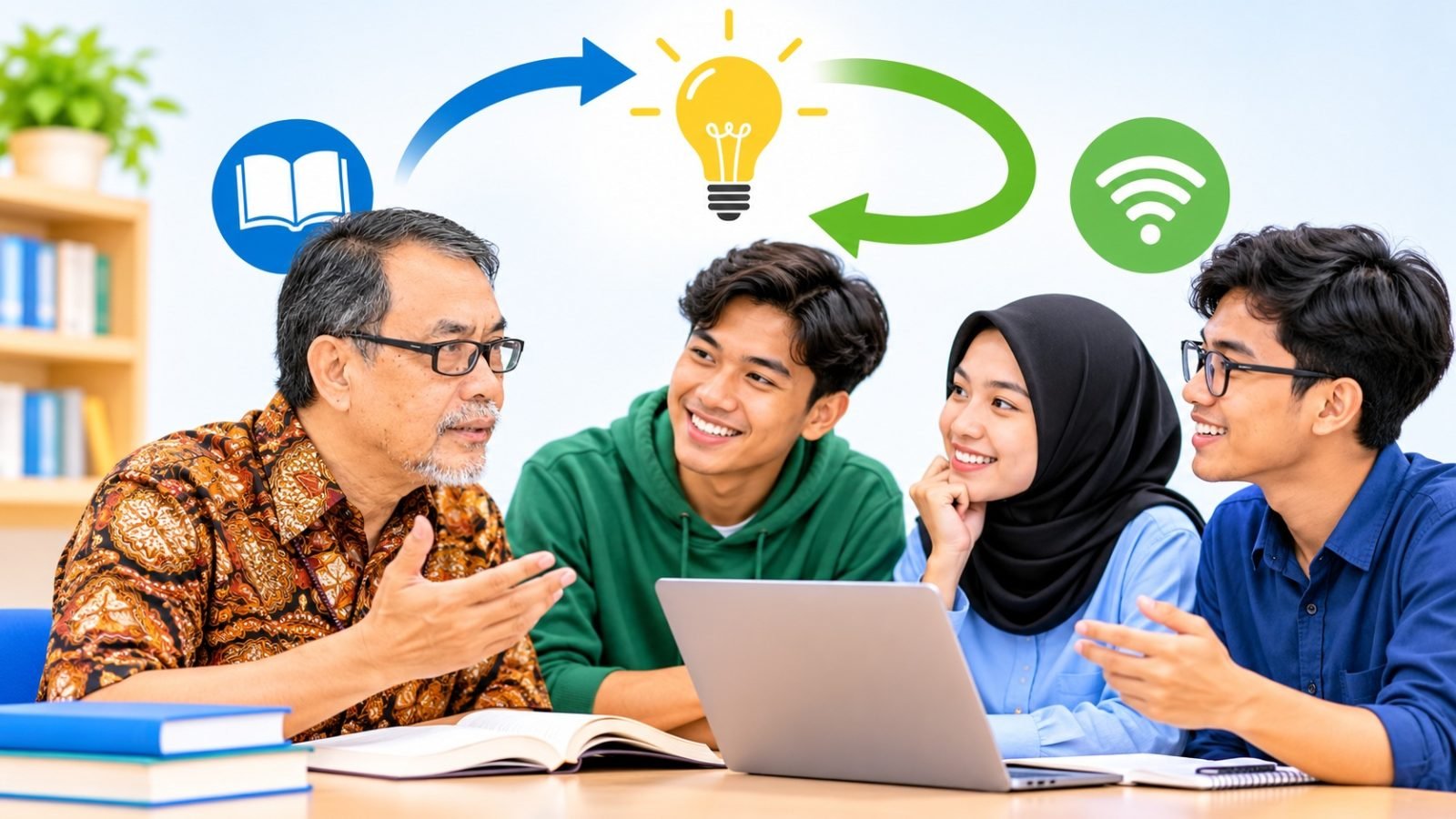
Sharing inspiration across generations is not a one-way process of passing down life experiences and values, but rather a reciprocal dialogue rooted in empathy, mutual respect, and a willingness to learn, so that the wisdom of the senior generation blends with the innovation of the younger generation to build an education that is more humane and adaptive to the changing times.
WHAT is meant by sharing in the title of this article is from Baby Boomer generation lecturers (born 1946-1964) to Gen Z students (born 1997-2012). This is a crucial topic of discussion because of the digital divide, cultural values, and communication styles that are highly contrasting between the two generations. As a retired lecturer who has been entrusted again to share inspiration with students, it is certainly a relatively heavy burden of responsibility, because according to William Arthur Ward: “The mediocre teacher tells. The good teacher explains. The superior teacher demonstrates. The great teacher inspires.” Furthermore, there is an unfortunate event where an elderly Baby Boomer lecturer was rejected from the classroom by Gen Z students.
Baby Boomer lecturers are rich in life experience, loyalty, and resilience, while Gen Z students are very attached to digital technology, prefer instant things, visuals, and are pragmatic. Baby Boomer lecturers are accustomed to formal, hierarchical, and textual communication methods. Conversely, Gen Z students are digital natives who prefer fast, visual, and egalitarian communication. Baby Boomer lecturers share inspiration regarding life wisdom, professional ethics, emotional control, and long-term career networking. Gen Z students try to help lecturers understand the latest technology trends, artificial intelligence (AI), and current inclusive perspectives. The life experience of Baby Boomer lecturers, rich in values of resilience, loyalty, and hard work, is much needed by Gen Z students to face the real world.
Why do Baby Boomer lecturers need to learn and understand cross-generational sharing strategies? It is very important to:
1. Prevent Misunderstandings and Conflict
Every generation has different communication styles, values, and ways of processing information. Without the right strategy, these differences are often judged subjectively and trigger value clashes or debates. Understanding cross-generational strategies helps us realize that different ways of working are not obstacles, but data to complement each other.
2. Ensure Effective Knowledge Transfer
Baby Boomer lecturers or senior lecturers have a wealth of experience, dedication, and wisdom, while their students master digital trends, algorithms, and adaptive and fast ways of working. Knowing the strategy for sharing inspiration ensures that knowledge from the older generation (Baby Boomers) is not lost and new innovations from the younger generation (Gen Z) can be well absorbed by their lecturers.
3. Increase Innovation, Creativity, and Productivity
The results of HR and Organizational management studies conducted by Yesica Apriliana Paska and Hanung Eka Atmaja (2025) conclude that collaboration in a multigenerational environment is proven to significantly increase creativity and innovation. When mature viewpoints are combined with fresh new perspectives, the solutions generated for a problem become far more comprehensive and out-of-the-box.
4. Create an Inclusive and Mutually Respectful Environment
Intergenerational problems usually arise when one party feels unappreciated or misunderstood. By learning empathetic communication strategies, we are encouraged to put ourselves in others' shoes based on the context of the era they live in. This creates a safe, supportive, and inclusive work environment or community.
5. Pass Down Positive Values Sustainably
Sharing is not just about sharing material or work/tasks, but also sharing inspiration, instilling character, integrity, and social values. The right strategy ensures these values of goodness can be "translated" into a language relevant to Gen Z, so they are inspired and motivated to continue them for the future.
For the process of transferring knowledge and life values to run effectively without triggering conflicts of thought, here are strategies for sharing inspiration and their application as a bridge between generations:
1. Implement Two-Way Mentoring
Senior lecturers (Baby Boomers) share inspiration regarding wisdom and work ethic, mental resilience, loyalty, and leadership as well as theoretical depth to Gen Z students, while students share digital literacy and the latest technology trends. For inspiration to be conveyed effectively to Gen Z, the sharing process must not be one-way but must be mutual.
Example:
a. Real case analysis in the industry. Lecturers share historical perspectives, institutional wisdom, and empirical experience on how the industry solved similar problems in the past. Students contribute the open-mindedness perspective of Gen Z, such as inclusivity issues, environmental/sustainability impacts, and how netizens respond in the digital world today. This collaboration produces solutions that are structurally regulated in the typical Baby Boomer way but remain innovative and modern in the typical Gen Z way.
b. Baby Boomer lecturers share inspiration regarding life wisdom, ethics, profession, emotional control, and long-term career networking. Gen Z students help lecturers understand the latest technology trends, artificial intelligence (AI), and current inclusive perspectives. Through this collaboration, academic quality is maintained professionally, while the learning environment becomes healthier, more inclusive, and adaptive to the development of the times.
2. Implement Reverse Mentoring Methods
Instead of just using one-way top-down communication, lecturers can implement a mutual sharing system. Lecturers share wisdom, work ethics, and industry experience, while Gen Z students are invited to help or share the latest technology trends, social media, or applications. This results in Gen Z feeling valued and heard, making them more open to receiving advice and inspiration from lecturers.
3. Bridge the Communication Gap
Baby Boomer lecturers are accustomed to formal, hierarchical, and textual communication methods. Conversely, Gen Z are digital natives who like fast, visual, and equal communication. The strategy of sharing inspiration becomes a bridge so that the lecturer's message can be received without seeming "patronizing." It is necessary to change the lecture method into an interactive dialogue because Gen Z students get bored easily with long lecture methods.
This can be done by selecting/choosing among fellow students to be teaching assistants with mutual agreement.
4. Balance Mental Resilience and Information Speed
Gen Z has incredibly fast access to information but is prone to psychological anxiety. The life experience of Baby Boomer lecturers, rich in values of resilience, loyalty, and hard work, is much needed by Gen Z to face the real world.
Here are concrete examples of applying this balance in the campus environment:
a. Assignment Collection Method: Punctuality vs. Fast Feedback
Challenge: Baby Boomer lecturers like disciplined, structured, and hierarchical processes. Gen Z students are accustomed to high speed and expect instant feedback certainty.
Balancing: Lecturers use a Learning Management System (LMS) such as Google Classroom or Moodle. The course contract is made clear at the beginning; students are required to submit assignments on time through the system to meet the lecturer's discipline standards. In return, the lecturer commits to providing automatic or scheduled grades/feedback within 3 days after submission to meet the students' need for information speed.
b. Learning Method: Long Lectures vs. Project-Based Learning
Challenge: Baby Boomer lecturers are accustomed to one-way textbook-based lecture methods. Gen Z has a shorter attention span and is more easily anxious due to the burden of excessive digital information.
Balancing: Lecturers apply project-based learning. At the beginning of class, the lecturer gives a short theoretical lecture for 20–30 minutes, transferring knowledge and training students' mental focus. The remaining class time is used for group discussions based on real problems, where students are free to look for quick references via their gadgets.
c. Communication Outside Class: Formality vs. Mental Health Boundaries
Challenge: Baby Boomer lecturers prioritize formal manners (e.g., sending emails or text messages during working hours in standard language). Gen Z students are accustomed to exchanging instant messages at any time but are prone to stress if contacted suddenly outside of lecture hours.
Balancing: Lecturers agree on "Academic Communication Service Hours" (e.g., Monday-Friday 08:00–16:00). Students are taught to draft polite messages using templates provided by the lecturer. Outside those hours, students are prohibited from sending messages, and lecturers are not obligated to respond. This maintains the mental resilience of both parties to avoid burnout due to technology dependence.
d. Facing Criticism: Reverse Mentoring
Challenge: The Baby Boomer way of forging mentality with harsh sentences or the "back in my day it was harder" pattern often triggers performance anxiety in Gen Z. Conversely, Boomer lecturers can feel unappreciated if criticized directly by students.
Balancing: The campus facilitates consultation programs or end-of-semester evaluations that are anonymous and constructive. Lecturers act as mentors who share life resilience and toughness in facing pressure. Conversely, Gen Z students act as technology "buddies" who help lecturers filter digital information or operate the latest artificial intelligence (AI) tools for lecture research.
These strategies require the role of leaders in aligning the interests of Baby Boomer generation lecturers and Gen Z students. Leaders play an important role in building bridges between generations. A sensitive leader will ensure that the voice of every generation is heard, is also able to manage conflict wisely, and forms a team that complements each other, by working across generations—it is not about who is most correct, but how we can fill each other's gaps.
In the midst of rapid change, it is precisely that diversity of perspectives that enriches decisions and drives innovation. Now is the time for us to see differences not as obstacles, but as potential. With empathy, open communication, and a commitment to common goals, we can weave harmony in generational diversity. Because in truth, a strong organization is not just one that has superior resources, but one that is able to build bridges between humans of all ages.
Moch Suberi, Non-Permanent Lecturer at STIEKIA, YAP Board Member, Advisor to YBU & YPL