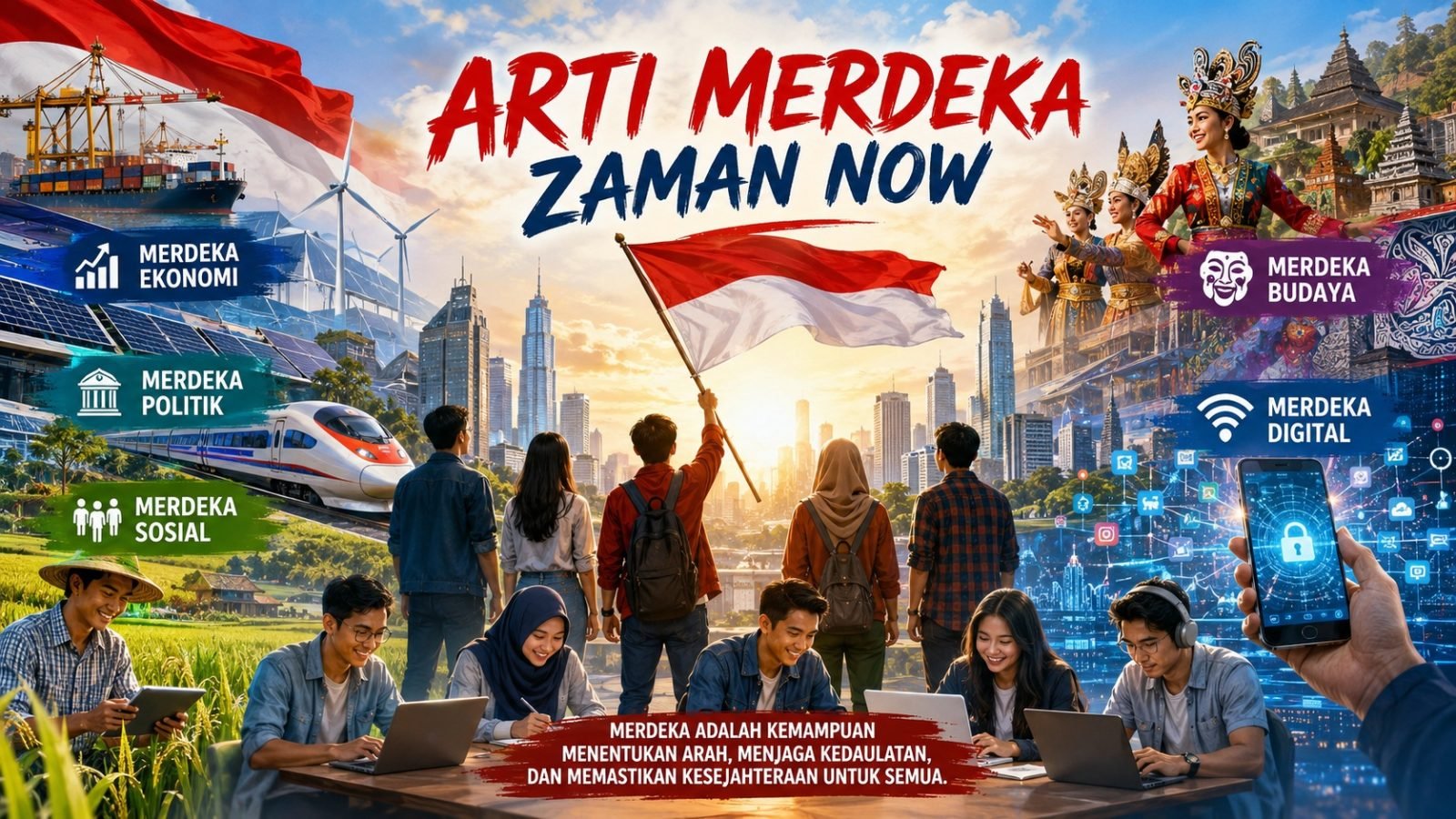
Every time August arrives, we are reminded of a word that is both so familiar and so profound in its meaning: INDEPENDENCE. So, what does independence mean in the modern era?
SINCE the Proclamation of Independence on August 17, 1945, Indonesia's independence was initially understood primarily as the liberation of the nation from colonization and colonial rule. The proclamation marked the birth of Indonesia as a nation entitled to determine its own destiny. However, after more than eight decades of the republic's journey, the question of independence does not stop at whether we have been freed from physical colonization.
A more relevant question is: have the Indonesian people truly felt independence in their lives?
Independence in the modern era has a much broader scope. It touches on economic, political, social, cultural, educational, informational, and even digital life. Independence is not merely a state where no other nation controls us. Independence also concerns the ability of the nation and its citizens to make choices, develop potential, express thoughts, obtain fair opportunities, and live with dignity without being in various forms of dependence and oppression.
Within the framework of Amartya Sen's thought, freedom can even be viewed as the primary goal of development. Sen (1999) asserts that development is essentially a process of expanding human freedom. Thus, economic progress is not enough to be seen from growth figures. It is also measured by how far humans obtain the opportunity to lead lives they value as worthwhile.
Therefore, commemorating independence in the modern era should be an opportunity to ask further: independent from what, independent for what, and independent for whom?
Economic Independence:
Unfinished Freedom
Being economically independent does not mean Indonesia must close itself off from capital, trade, technology, or international cooperation. In an interconnected world, economic relations between countries are an unavoidable reality and in many ways can actually provide benefits. What needs to be maintained is the ability to determine national interests amidst global economic relations.
Our constitution has actually provided a clear direction. Article 33 of the 1945 Constitution asserts that the economy is organized as a joint effort based on the principle of kinship. Branches of production that are important for the state and affect the lives of many people are controlled by the state, while the earth, water, and natural resources contained therein are utilized for the greatest prosperity of the people. The same article also asserts the principle of self-reliance in the implementation of the national economy.
Therefore, the issue of economic independence is not just about the presence or absence of foreign companies in Indonesia. The presence of foreign investment can provide capital, technology, jobs, and market access. The issue is whether these relationships provide fair benefits to the community and strengthen national capabilities in the long term.
Economic independence means that the community has the opportunity to obtain decent work, national business players have room to grow, farmers and fishermen obtain adequate bargaining positions, natural resources are managed responsibly, and the results of development are not concentrated in a handful of groups.
This is where economic independence meets social justice.
A nation may have tall buildings, impressive economic growth, and continuous investment. However, if most of the people still find it difficult to obtain decent work, quality education, affordable food, and access to economic opportunities, then the question about the meaning of economic independence remains relevant. Economic independence, therefore, is being able to stand tall in the midst of the world.
Political Independence:
Freedom That Must Be Guarded
In the political sphere, independence means that the people have the right to determine the direction of state life through honest, open, and accountable democratic mechanisms.
Indonesia has chosen democracy as one of the foundations of state life. Therefore, political independence is not sufficiently realized through the holding of elections. Democracy also requires freedom of speech, freedom of association, a press that can carry out a control function, state institutions that work based on the law, and a government that can be held accountable to the people.
The challenges of political independence in the modern era are even more complex. The influence of capital, oligarchy, identity politics, abuse of power, corruption, disinformation, and manipulation of public opinion can affect the quality of democracy. This is where we need to be careful in using the term “freedom.” Political freedom is not freedom without limits. Freedom must go hand in hand with responsibility, law, ethics, and respect for the rights of others.
Political independence also does not mean that Indonesia must completely reject relations with other countries. In international relations, cooperation, diplomacy, trade, and international organizations are part of modern state life. What needs to be guarded is that such cooperation does not eliminate Indonesia's ability to determine national interests based on the constitution and the will of the people.
A healthy democracy is a matter of for whom that power is used. Lord Acton once reminded us that power has a tendency to be abused. Therefore, the greater the power held by a person or an institution, the stronger the oversight mechanism required. Political independence will lose its meaning if the people are free to choose, but after that, they do not have adequate space to oversee power.
Social Independence:
Independent Without Degrading
Social independence means that every citizen has dignity and equal opportunity as a human being and as a citizen.
Indonesia has indeed made much progress. However, various forms of inequality can still be found in daily life, such as: economic inequality, educational gaps, differences in access to public services, discrimination, and limited opportunities for certain community groups. Therefore, social independence must not stop at the slogan of “equality.” Equality before the law must be followed by fairer opportunities in real life.
Amartya Sen (1999) reminds us that a person's freedom is greatly influenced by the social opportunities available to them. Political freedom, economic opportunity, education, health, and social security are interconnected. A person who is formally free but does not have the opportunity to obtain education, work, health, or a decent life is actually still facing limitations in using their freedom.
Therefore, the measure of a nation's independence cannot be seen solely from the freedom of the strongest group. It must also be seen from how far those who are weak obtain the opportunity to rise. Social independence is when a farmer's child has the opportunity to become a scientist, a laborer's child can become an entrepreneur, a child from a simple family can obtain quality education, and every citizen can obtain public services without being treated differently because of their background.
So, independence becomes meaningful when human dignity is not determined by wealth, position, lineage, or closeness to power.
Cultural Independence:
Rooted, but Not Closed Off
Globalization makes intercultural encounters happen faster. Music, film, food, language, lifestyle, and various cultural products from various parts of the world can be present almost simultaneously in our living space. In such a state, the question of cultural independence becomes increasingly important.
Being culturally independent does not mean rejecting foreign culture. Closing oneself off from the world is not the only way to maintain identity. On the contrary, a living culture is precisely a culture that is able to engage in dialogue with change, accept good influences, while still having the ability to determine the values it wishes to maintain.
UNESCO (2005) asserts that cultural diversity is a wealth of society and that the protection of culture needs to go hand in hand with openness to other cultures. Thus, maintaining culture does not have to mean building walls against the outside world.
Indonesia has extraordinary cultural wealth: regional languages, traditional arts, literature, architecture, food, clothing, traditions, local knowledge, and various life values passed down from generation to generation. However, culture will not survive just because we praise it. Culture must be learned, practiced, developed, and passed on.
Cultural independence means we do not lose the ability to say: this is who we are, these are the values we believe in, and this is the heritage we want to pass on to the next generation. An independent nation does not have to be afraid of world culture. It is enough to have strong roots so that it is able to interact with the world without losing its identity.
Digital Independence:
Free in a Space That Is Not Entirely Free
This is one form of independence that perhaps was never imagined by the independence fighters of 1945. Today, humans live in a digital space. We work, learn, communicate, shop, engage in politics, seek entertainment, and even build identities through the internet.
Digital space provides extraordinary freedom. Anyone can obtain information, express opinions, build communities, and even generate work and income. However, digital space also presents new forms of power.
Manuel Castells (2007) shows that in a network society, media and communication space become one of the important arenas where power is formed and contested. This means that digital technology is not a completely neutral space. Within it are algorithms, technology companies, economic interests, political power, and user behavior that together shape how information circulates. Therefore, being independent in digital space is not just about being free to access the internet. Being digitally independent means being able to use technology without losing control over oneself.
We need to be able to distinguish between information and disinformation, fact and manipulation, criticism and slander, freedom of speech and insult. We also need to realize that personal data has value and must be protected. Indonesia itself already has Law Number 27 of 2022 concerning Personal Data Protection which places personal data protection as part of the protection of citizens' rights.
Thus, “digital colonization” in the modern era does not always take the form of someone directly forcing us to do something. It can appear more subtly: when our attention is constantly controlled, when our personal data is used without adequate understanding, when our opinions are shaped by information that is deliberately manipulated, or when we become so dependent on technology that we lose the ability to make choices consciously.
Therefore, digital independence requires literacy, ethics, awareness, and responsibility. We may use technology. But do not let technology end up using us (Estede, 2026).
Human Independence:
Independent to Determine the Direction of Life
Of all these forms of independence, there is one thing that is actually the center of attention, namely: humans. The economy is built for humans. Politics is run for humans. Education, culture, technology, and development must also ultimately return to human interests.
Therefore, the measure of independence should not only be seen from the strength of the state, economic growth, technological sophistication, or the amount of formal freedom possessed by citizens. A more fundamental measure is: are the Indonesian people increasingly able to determine the direction of their lives with dignity?
Can children grow up with a good education? Can the elderly enjoy their old age decently? Can the community work and earn a decent income? Can the people express their opinions without fear? Does the law apply fairly? Can culture develop? Can the community use technology without becoming an object of exploitation? And most fundamentally: does development make humans more humane?
Such questions make the meaning of independence far deeper than just an annual celebration.
Independent Does Not Mean Alone
There is one thing that needs to be straightened out in understanding independence in the modern era. Independent does not mean not needing other people. Independent also does not mean rejecting international cooperation, investment, global trade, technological progress, or cultural exchange. An independent nation is precisely able to work together without losing the ability to determine its stance.
We may learn from other nations without losing our identity. We may accept investment without surrendering all national interests. We may use foreign technology without losing control over our data and our lives. We may enjoy global culture without forgetting our own culture.
In other words, independence is not alienation from the world, but the ability to stand on equal footing in the midst of the world. This is where the meaning of independence becomes more mature.
Independence is not just “free from,” but also “free to”: Free from colonization, as well as free to build. Free from fear, as well as free to speak the truth. Free from poverty, as well as free to develop capabilities. Free from discrimination, as well as free to live with dignity. Free from information manipulation, as well as free to think critically. And free from harmful dependence, as well as free to build mutually strengthening cooperation.
The Struggle Is Not Over
Therefore, when we sing struggle songs and fly the Red and White flag every August, do not let independence stop as a historical memory.
Independence is an ongoing work. In the past, the fighters took up arms to defend the republic. Today, that struggle takes place in a different form: fighting poverty, ignorance, corruption, injustice, discrimination, harmful dependence, environmental damage, abuse of power, and information manipulation.
The enemy of independence in the modern era does not always come in uniform and with weapons. Sometimes it comes as injustice that is allowed, greed that is considered normal, lies that are repeated, dependence that is not realized, or technology that is used without moral control. Therefore, commemorating independence should not just be about remembering how this nation once succeeded in becoming independent.
We also need to ask: What still makes our people not fully feel independence? And further: What can we do so that the independence fought for by our predecessors is truly present in the lives of today's generation and future generations?
The meaning of independence in the modern era is not just the ability to say “we are independent.” The meaning of independence is the ability to ensure that independence is felt, guarded, and passed on.
Because a nation is not yet fully independent if some of its people still live without opportunity, if power can be bought, if its own culture loses its place in its home, if its citizens are easily controlled by false information, if the progress achieved is only enjoyed by a small part of society.
So, after 1945, the struggle for independence is indeed not over. The field has changed. The form of the challenge has changed. The technology has changed. However, the ideals remain the same: to build the life of a nation that is independent, united, sovereign, just, and prosperous.
So, the meaning of independence in the modern era is when we are able to determine the direction without losing our way; able to open ourselves without losing our identity; able to use freedom without losing responsibility; and able to build progress without leaving humans behind.
Suprapto Estede, lecturer of Pancasila at Stiekia, developer of technology acceptance models, digital character theory, and human behavior based on Islamic values.