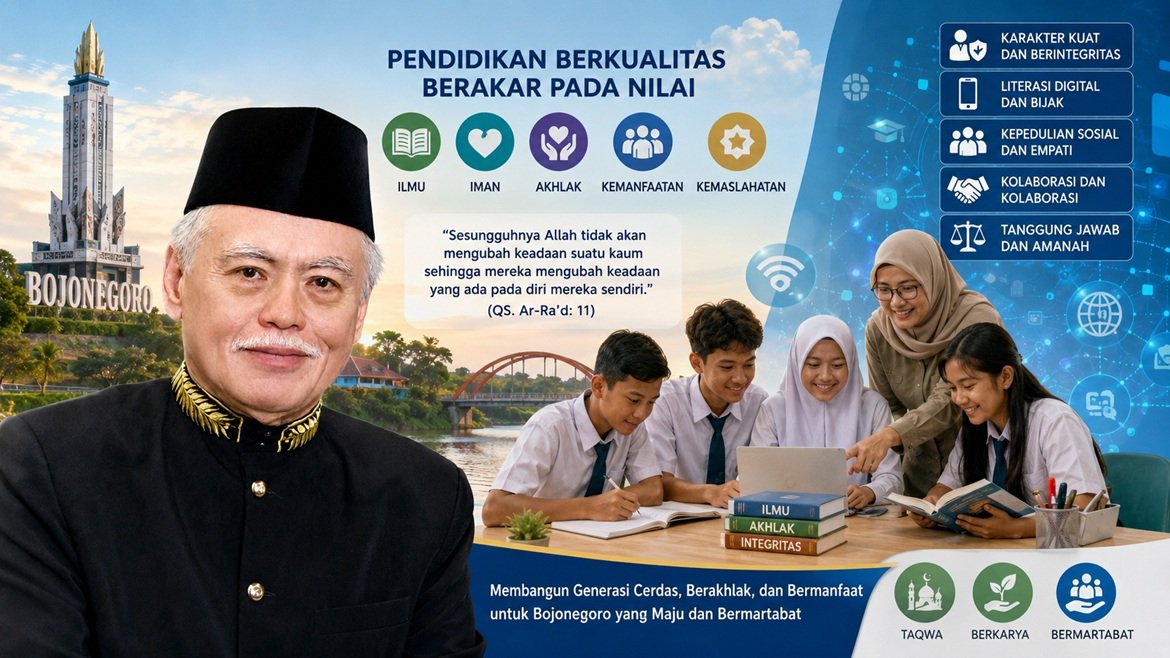
Successful education is education that produces human beings capable of upholding trust, exercising self-control, respecting humanitarian values, and bringing benefit to society.
EDUCATION has always been the primary foundation in building civilization. Therefore, every educational policy is not merely about budgets, school buildings, curricula, or school participation rates, but about what kind of human beings we want to shape. In this perspective, the article Bojonegoro Education Direction 2026 published by Damarinfo deserves appreciation because it describes the Bojonegoro Regency Government's commitment to improving the quality of human resources through various strategic programs, ranging from the Education Endowment Fund, scholarships, and teacher competency improvement, to the equitable distribution of educational access. However, has the direction of educational development truly been aimed at shaping human behavior based on values?
So far, the success of education has been measured more through quantitative indicators, such as school participation rates, graduation rates, accreditation, academic achievement, and graduate competitiveness. All these indicators are indeed important. However, these measures have not fully answered whether education has succeeded in producing human beings who are honest, responsible, have integrity, are empathetic, and are capable of using knowledge for the common good.
In the perspective of Islamic value-based behavior, the goal of education goes far beyond the process of knowledge transfer. Education is an endeavor to shape human beings who possess unity between knowledge, faith, and action. Knowledge gains its meaning when it is manifested in behavior that reflects moral and spiritual values.
This view is in line with the modern behavioral theory proposed by Ajzen (1991). According to him, a person's behavior is preceded by intention, while intention is influenced by attitudes toward behavior, social norms, and perceptions regarding the ability to carry it out (Ajzen, 1991). In the Islamic perspective, this framework can be enriched with dimensions of faith, sincerity of intention, piety, moral responsibility, and the awareness that every action is accounted for before Allah SWT. Thus, a person's decisions are not based solely on cost-benefit considerations, but also on the values of truth and benefit.
The Qur'an provides a very strong foundation regarding the importance of behavioral change as the core of community development.
"Indeed, Allah will not change the condition of a people until they change what is in themselves." (QS. Ar-Ra'd: 11).
This verse shows that social change does not begin with physical development, but from changes in the way humans think, behave, and act. Therefore, education becomes the main instrument in building civilization.
If the direction of Bojonegoro's education wants to produce long-term impacts, then investment in the education sector should be understood as an investment in character building. Scholarship programs, improving teacher quality, school construction, and the provision of the Education Endowment Fund will provide broader benefits if all these policies are consistently directed toward fostering honesty, responsibility, discipline, social concern, learning ethos, and the integrity of students.
The challenges of modern education are also increasingly complex. The digital era presents various new problems, such as the spread of hoaxes, hate speech, cyberbullying, instant culture, low digital literacy, and declining ethics in public spaces. This condition shows that intellectual intelligence alone is no longer sufficient. Education requires the strengthening of moral and spiritual dimensions so that students are able to use technology wisely and responsibly.
In this regard, digital character building becomes an inseparable part of the goals of education. Students need to be guided to have moral awareness in using digital media, respecting the truth of information, maintaining communication ethics, respecting the dignity of others, and utilizing technology to bring benefits to society. Such digital character will strengthen the quality of human resources while simultaneously reinforcing a harmonious social life.
This thought is in line with the goal of Islamic education as proposed by Al-Attas (1991), that education aims to form a good man (the good man), which is a human being who is knowledgeable and civilized. Previously, Al-Ghazali had emphasized that knowledge that does not produce morality will lose its value and direction. Therefore, the success of education is not sufficiently measured by intellectual intelligence alone, but also by the quality of morality reflected in daily behavior.
The Direction of Bojonegoro's Education provides optimism that human resource development is receiving increasing attention. The next challenge is to ensure that every educational policy is truly oriented toward the formation of a whole human being, namely: intelligent in thought, mature in personality, noble in character, and responsible in utilizing science and technology.
Thus, successful education is not just about producing graduates who are ready to enter the workforce. Successful education is education that produces human beings capable of upholding trust, exercising self-control, respecting humanitarian values, and bringing benefit to society. That is where educational investment finds its deepest meaning, namely building civilization through the formation of behavior rooted in noble values.
Suprapto Estede, lecturer at STIEKIA, advisor to ICMI Orda Bojonegoro.